

Asus Maximus Xi Hero Fan Control
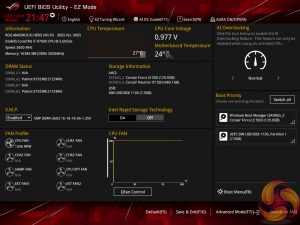
The default entry folio for ASUS' UEFI is EZ Way. On this page, basic settings relating to fan speeds and boot devices can be adapted and other of import information can be viewed. EZ Style is simple enough for novice users to non be dissuaded from entering the UEFI.
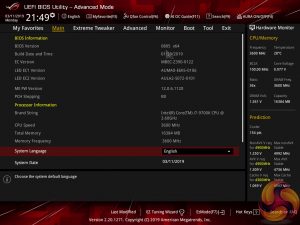
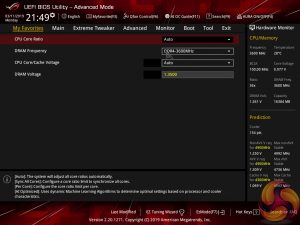
Hitting F7 allows the Avant-garde way to be accessed. The Main page outlines information relating to the system and motherboard. The My Favorites tab can be user-friendly if you are often searching for a setting cached deep within the UEFI.
Extreme Tweaker follows the standard layout that nosotros have come to expect from recent ASUS motherboards, and that'southward a good thing. Like shooting fish in a barrel access is provided to ratio, frequency, and voltage settings, assuasive users to adjust their arrangement parameters with minimal effort. Dissimilar voltage operating modes are available for the CPU, allowing the user to adapt an overclock to their own preference. These modes are: Offset, Adaptive, and Manual, also equally Auto. No hybrid modes are provided; override + get-go would have been useful.
I am glad to come across ASUS include a pop-upwards alert screen highlighted when forced multi-core turbo speeds volition exist practical and giving the user the option to deactivate the 'feature'.
Three subsections inside Extreme Tweaker provide users with additional overclocking abilities – External Digi+ Power Control, Internal CPU Power Management, and Tweaker's Paradise.
Load-line scale settings tin can be accessed through the External Digi+ Power Control page. ASUS provides options from level i to level 8 and gives a basic caption of how the voltage changes with increasing levels. Visual estimation using a graph would be a preferable mode of explanation.
Settings within the AI Features subsection are effectively used to bias the automatic overclocking assailment when using AI OC Guide (accessed via F11). The libation evaluation settings tin can also exist used to give one's CPU cooler a points-based score which then feeds into the AI OC Guide algorithm.
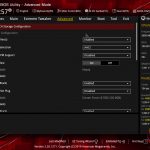
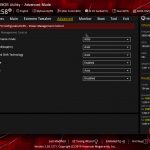
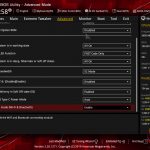
The Avant-garde tab is where options relating to storage and onboard devices can be adjusted.
Under the Onboard Devices page, performance mode of the chipset-fed PCIe 3.0 full-length slot needs to be adjusted in order to become full PCIe three.0 x4 bandwidth. This subsection too provides an pick for the onboard RGB lighting to be enabled or disabled during sleep and power-off modes.
ASUS gives a wealth of information relating to voltages, temperatures, and fan speeds, as displayed in the Monitor UEFI folio. Warnings relating to low fan speed can likewise be ready to warn a user of a failed fan, for example.
Fan speed control in ASUS' UEFI is very good. In that location are multiple methods of controlling the fan speed curve and several pre-determined modes are also available. Fans tin can also have temperature readings from dissimilar sources in order to meliorate tune their operation to a user' cooling preference.
Hitting F6 loads upwardly ASUS' Q-Fan Control GUI which is a graphical method of adjusting the fan speed curve. All fan headers are given control in Q-Fan past using a 3-betoken bend. The CPU fan header is given the greatest flexibility as the minimum fan speed it supports is xx%. The not-CPU headers can only get to lx% as their minimum fan speed setting in PWM control mode.
There is, however, a Fan Off setting for the non-CPU fans that allows them to power down when the relevant temperature conditions are met. While this is a useful feature in theory, I accept previously seen fans succumbing to motor twitch in this style, and the spring from 0% speed to 60% is generally aural.
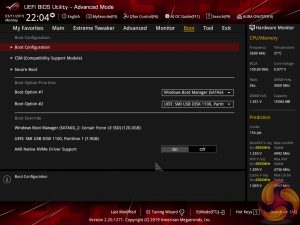
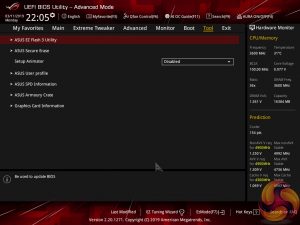
Key kicking settings can be easily accessed via the dedicated tab. The Tool section is home to ASUS' useful features, such every bit Secure Erase and EZ Flash 3 Utility.
EZ Flash 3 has the ability to update the BIOS using a storage device or over the web. Upward to eight settings profiles tin can be saved and named in the UEFI. SSD Secure Erase is a useful tool for securely wiping the contents of an SSD if you lot are selling information technology on, for example. There is also the possibility that wiping the data will restore functioning, though this was more prevalent with older SandForce drives.
Further profiles can be transferred through storage mediums such equally a USB flash drive. GPU Post and ASUS SPD Information can be useful in troubleshooting scenarios such as identifying dead or disconnected hardware without tearing one's system apart.

The search part is useful for quickly jumping to specific sections. ASUS gives quick admission to a toggle that allows the Aureola LED fashion to be adjusted.
EZ Tuning has been relegated to RAID setup and configuration duties, with AI OC Guide replacing information technology equally the automated overclocking style.
AI Overclocking Guide is ASUS' UEFI-led automated overclocking solution. Entered via a printing of F11, the guide features a gear up of in-depth paragraphs relating to its function, the significant of specific settings, and additional notes.
The algorithm that ASUS uses to suit CPU clock speed is, at least in part, driven by a bias for CPU cooling performance. This ties back to an aforementioned section that allows for adjustment of the CPU libation point scoring.
In our brief testing, setting the optimism value to '100' saw the AI Overclocking Guide set our Core i7-9700K CPU at four.9GHz for AVX and non-AVX workloads. The cavalcade on the right side of the screen suggested that 1.25V would be required for non-AVX workloads at iv.9GHz and i.309V for AVX workloads at the aforementioned frequency. These voltage levels are reasonable for running a Cadre i7-9700K with potent cooling.
Adjusting the optimism value to '150' saw the tool fix our CPU to 5.2GHz. The suggested voltage was 1.337V for non-AVX and 1.375V for AVX workloads. This is in a voltage region where nosotros would not necessarily feel comfortable running our system for long-term operation.
The information delivered by this unique tool is skillful. However, we cannot see enthusiasts favouring this approach over transmission overclocking.
Become a Patron!
Be sure to check out our sponsors shop EKWB here
Pages: 1 2 iii 4 v 6 7 eight 9 10 11 12
Source: https://www.kitguru.net/components/motherboard/luke-hill/asus-rog-maximus-xi-hero-wi-fi-z390-motherboard-review/4/
0 Response to "Asus Maximus Xi Hero Fan Control"
Post a Comment